


Showing posts with label Bob Cole Conservatory Choir. Show all posts
Showing posts with label Bob Cole Conservatory Choir. Show all posts
6/08/2010
Bob Cole Consevatory Choir presents Recital at Frauenkirche in Dresden on June 8 at 5:30 pm
 The Bob Cole Conservatory Choir under the direction of Dr. Jonathan Talberg was granted permission to present a special recital at the famous Frauenkirche in Dresden, Germany on June 8 at 5:30 pm during their 2010 Incantato Performance Tour to Central Europe.
The Frauenkirche Dresden can look back on a 1000-year history. Already its predecessor churches were dedicated to the Mother of God and called Frauenkirche. In the 18th century, the famous dome structure by George Bähr was built and dominated Dresden’s cityscape for 200 years. The church was destroyed shortly before the end of World War II. Its ruin remained as a memorial at the heart of the city. For more information on the history and significance of this venue, please visit the official Frauenkirche website.

6/06/2010
Bob Cole Conservatory Choir the featured guest performer at Tyn Church in Prague at 9 pm on June 6
 Another prime venue awaits the CSULB singers under the direction of Dr. Jonathan Talberg on the Bob Cole Conservatory Choir's 2010 Incantato Tour to Central Europe: The Tyn Church, a landmark of Prague and also the most popular church for the inhabitants of the Czech Capital city. The singers from Long Beach California were invited to sing during a special service on June 6 at 9 pm.
From Wikipedia: The Church of Our Lady before Týn (in Czech Kostel Matky Boží před Týnem, also Týnský chrám (Týn Church) or just Týn) is a dominant feature of the Old Town of Prague, Czech Republic, and has been the main church of this part of the city since the 14th century. The church's towers are 80 m high and topped by four small spires. In the 11th century, this area was occupied by a Romanesque church, which was replaced by an early Gothic Church of Our Lady in front of Týn in 1256. Construction of the present church began in the 14th century in the late Gothic style under the influence of Matthias of Arras and later Peter Parler. By the beginning of the 15th century, construction was almost complete; only the towers, the gable and roof were missing. The church was controlled by Hussites for some time, including John of Rokycan, future archbishop of Prague, who became the church's vicar in 1427.The roof was completed in the 1450s, while the gable and northern tower were completed shortly thereafter during the reign of George of Podebrady. His sculpture was placed on the gable, below a huge golden chalice, the symbol of the Hussites. The southern tower was not completed until 1511, under Matěj Rejsek. In 1626, after the Battle of White Mountain, the sculptures of George of Podebrady and the chalice were removed and replaced by a sculpture of the Virgin Mary, with a giant holy made from by melting down the chalice. In 1679 the church was struck by lightning, and the subsequent fire heavily damaged the old vault, which was later replaced by a lower baroque vault.Renovation works carried out in 1876-1895 were later reversed during extensive exterior renovation works in the years 1973-1995. Interior renovation is still in progress.For more info, please visit: http://en.wikipedia.org/wiki/Church_of_Our_Lady_before_T%C3%BDn
6/05/2010
CSULB students visit magical Cesky Krumlov on June 5
 Český Krumlov is a small city in the South Bohemian Region of the Czech Republic, best known for the fine architecture and art of the historic old town and Český Krumlov Castle. Old Český Krumlov is a UNESCO World Heritage Site and was given this status along with the historic Prague castle district. The city is named Český Krumlov ("Bohemian Krumlov") to differentiate it from Moravský Krumlov ("Moravian Krumlov") in the southeast of the country.
Construction of the town and castle began in the late 13th century at a ford in the Vltava River, which was important in trade routes in Bohemia. In 1302 the town and castle were owned by the House of Rosenberg. Emperor Rudolf II bought Krumlov in 1602 and gave it to his natural son Julius d’Austria. Emperor Ferdinand II gave Krumlov to the House of Eggenberg. From 1719 until 1945 the castle belonged to the House of Schwarzenberg. Most of the architecture of the old town and castle dates from the 14th through 17th centuries; the town's structures are mostly in Gothic, Renaissance, and Baroque styles. The core of the old town is within a horseshoe bend of the river, with the old Latrán neighborhood and castle on the other
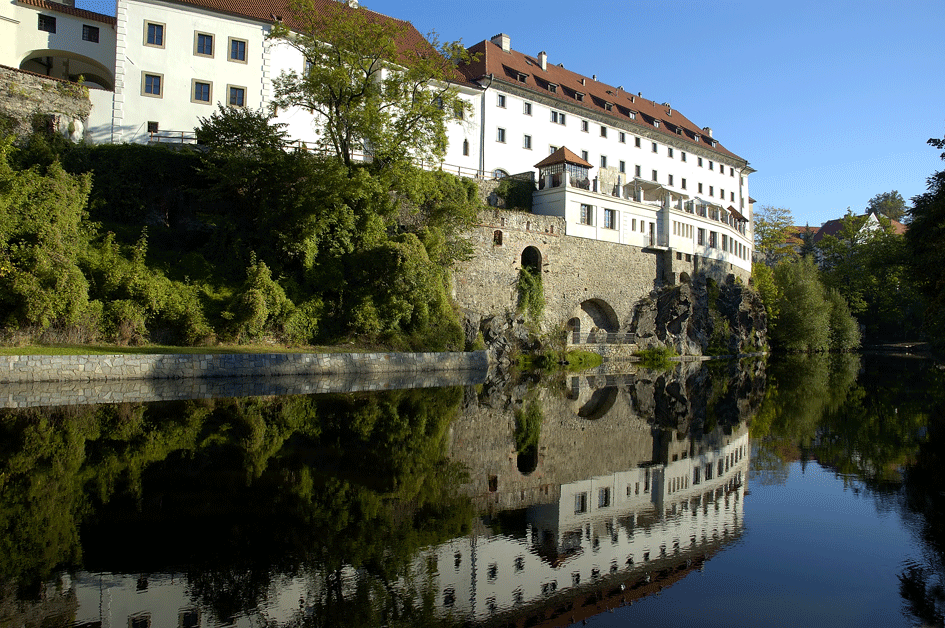 side of the Vltava. The town was seat of Duchy of Krumlov. 8,662 inhabitants lived in Krumau an der Moldau in 1910, including 7,367 Germans and 1,295 Czechs. During the interwar era it was part of Czechoslovakia. Between 1938 and 1945 it was annexed by Nazi Germany as part of the so-called Sudetenland. The town's German-speaking population was expelled after liberation by the American Army during World War II and it was restored to Czechoslovakia. During the Communist era of Czechoslovakia, Krumlov fell into disrepair, but since the Velvet Revolution of 1989 much of the town's former beauty has been restored, and it is now a major holiday destination popular with tourists from Germany, Austria, and beyond. In August, 2002, the town suffered from damage in the great flood of the Vltava River.
Český Krumlov Castle is unusually large for a town of Krumlov's size; within the Czech Republic it is second in extent only to the Hradčany castle complex of Prague. Inside its grounds are a large garden, an extensive bridge over a deep gap in the rock upon which the castle is built and the castle itself, which in turn consist of many defined parts dating from different periods of time. Church of St. Vitus (Kostel Sv. Víta) is a Gothic church dating back to the 15th century with frescoes from the same period. Český Krumlov Castle preserves its Baroque theatre (completed 1766), complete with original stage machinery, scenery and props:, one of only a few such court theatres that still exist. Due to its age, the theatre is only used three times a year (only two are open to the public), when a Baroque opera is performed in simulated candlelight. The castle's last private owner was Adolph Schwarzenberg. It was here that he received President Edvard Beneš and gave him a large contribution for the defence of Czechoslovakia against the growing threat of Nazi Germany. His property was seized by the Gestapo in 1940 and then confiscated by the Czechoslovak government in 1945. Krumlov has a museum dedicated to the painter Egon Schiele, who lived in the town. Ten kilometers from Krumlov is one of Bohemia's oldest monasteries, Zlatá Koruna ("The Golden Crown"). About 30 km from Krumlov is the Hluboka Castle, established in the twelfth century and later remodelled in imitation of Windsor Castle. Krumlov is close to the Šumava National Park, the Czech Republic's largest national park. The Šumava mountains lie along the border with Austria and Germany and offer a range of natural habitats - peat bogs, Alpine meadows, old-growth forests, lakes, and rivers. The area is popular with walkers, cyclists, and canoeists on the Vltava. Cesky Krumlov is only a short distance from the man-made Lake Lipno, on which many people take boat trips to various small towns on the lake and also to the Dam, which is a Hydro-electic power plant. Český Krumlov is home to Pivovar Eggenberg brewery. It has also been used as filming locations for movies such as the 2006 films "The Illusionist" and "Hostel" as well as the 1970s German movie "Traumstadt".
6/04/2010
How good is your Slovak? The Bob Cole Conservatory Choir concert at St. Martin's Cathedral in the media
Koncert v Katedrále sv. Martina
V stredu, 2. júna 2010 o 17:00, sa v Katedrále svätého Martina uskutočnil koncert spevokolu z The Bob Cole Conservatory z Californie. Týmto koncertom odštartovali svoje turné po Európe. Za začiatok svojej koncertnej šnúry si zvolili práve Bratislavu.
V nasledujúcich dňoch navštívia so svojim repertoárom Rakúsko, Česko a zakončia koncertom v Berlíne. Toto teleso mladých študentov predviedlo v bratislavskej katedrále vysoko profesionálny výkon a priniesli naozaj hlboký duchovný a umelecký zážitok. Škoda len, že verejnosť bola slabo informovaná a na koncerte sa zúčastnilo iba zopár ľudí.
 |
 |
 |
 |
http://csulb-incantatotour.blogspot.com/2010/06/more-impressions-from-bob-cole.html
http://csulb-incantatotour.blogspot.com/2010/06/dinner-at-staroslovenska-krcma-in-old.html
http://csulb-incantatotour.blogspot.com/2010/06/flyin-lufhansa-and-lovin-bratislava.html
http://csulb-incantatotour.blogspot.com/2010/06/debut-concert-for-bob-cole-conservatory.html
Text a foto: Milan Cehlárik
6/03/2010
More standing ovations for the Bob Cole Conservatory Choir in Austria
 "I love this church", commented Dr. Jonathan Talberg on late Thursday night on the phone from beautiful Göttweig where the Bob Cole Conservatory Choir performed to a small yet very appreciative audience in the magnificent Stiftskirche - the perfect setting for Mendelssohn's "Heilig" sung in double choir from the altar area. Rainy weather and a national holiday brought only 32 listeners to the Benedictine Abbey, but they sure made some noise. Especially two older ladies who were so moved by the concert yet also extremely upset about the lack of a full house for the singers from Cal State Long Beach that they even yelled at one of the Father accusing him of not spreading the word about the event more: "Das war der beste Chor, der hier je gesungen hat und keiner wusste davon", one lady said: "This was the best choir we ever had here and nobody knew they were coming". No that nobody knew is hard to believe as a quick google search produced about 512 results for the concert listing and Incantato's concert management team had done their homework as well by sending out press releases to the media along with personal invites to local fans of choral music, but the national holiday on the Thursday is for many locals a reason to pack the whole family and go on a long weekend trip which combined with rainy weather and floods that keep the tourists away, can result in only a small crowd. "It didn't really matter so much", Talberg added. "The choir sounded amazing and we had a lot of fun." Last not least, the choir was asked for an encore and received two standing ovations - quite unusual for European audiences who are not known for showing such public displays of enthusiam, especially not in church. "It was a perfect day", their director concluded. After departing from Bratislava, the singers from CSULB had first stopped at Melk Abbey where they had been granted permission to sing a full set of sacred selections (another rare moment) and then continued on to Goettweig for a private reception, tour and rehearsal of the magnificent abbey perched high upon a hill that looks and feels like a fairy tale castle. And the best part of the day? Well, it sounded like the night ahead of them at the former boy school dormitory right next to the pink church where the group is staying for two nights. The only downside is that we will have to wait for actual pictures at least until tomorrow. While there is a gourmet restaurant just around the corner where they had dinner already and breakfast will be served for Dr. Talberg and his students, the Abbey does not offer wifi or any internet services. Auf Wiedersehen - Sandra for the CSULB gang in Göttweig, Austria!
6/02/2010
A prime venue with perks: Next Cole Conservatory Choir Concert at the Benedictine Abbey of Goettweig on June 3 at 7:30 pm
The Benedictine Abbey situated on the Göttweig Mountain, is - because of its location - sometimes called the Austrian Montecassino. The Monastery founded in 1083 by Saint Altmann sits on a hill 449 m above sea level in the Dunkelsteiner Forest south oft the city of Krems, on the eastern edge of the world-famous Danube Valley called the Wachau. With the Wachau, Göttweig was in 2001 placed on the UNESCO World Heritage List. And on Thursday, June 3, 2010, the Bob Cole Conservatory Choir will be performing in the prestigious Stiftskirche pictured below at 7:30 pm. 
At first, Augustines worked here, to be followed in 1094 by Benedictine monks from the Monastery of St. Blasien in the Black Forest. The Benedictines have been living, learning and teaching on Göttweig Mountain for more than 900 years. The goal of their life is to glorify God in prayer and work according to the Rule of their Order’s founder, Saint Benedict, the Patron Saint of Europe. Currently 54 monks belong to the monastic community. More than 30 of them give pastoral care to parishioners and pilgrims in the Dioceses of Vienna and St. Pölten.Forestry and viticulture have been the economic basis of the Monastery since it was founded - today completed by various touristic and economic efforts.
Incantato is very proud to co-organize concerts in the Benedictine Abbey’s magnificent Stiftskirche. For more information, visit the official website Benediktiner Stift Goettweig
The Bob Cole Conservatory Touring Choir has the unique opportunity to stay overnight in the former boys school dormitory, now a guest house for youth. While the website is only in German, the pictures will give you a pretty good idea about the place and I can only tell you from various experiences how magical it is too stay there as you feel like living in a castle (okay, not the fancy part of it, but still).
Auf Wiedersehen in Austria. Eintritt ist frei
At first, Augustines worked here, to be followed in 1094 by Benedictine monks from the Monastery of St. Blasien in the Black Forest. The Benedictines have been living, learning and teaching on Göttweig Mountain for more than 900 years. The goal of their life is to glorify God in prayer and work according to the Rule of their Order’s founder, Saint Benedict, the Patron Saint of Europe. Currently 54 monks belong to the monastic community. More than 30 of them give pastoral care to parishioners and pilgrims in the Dioceses of Vienna and St. Pölten.Forestry and viticulture have been the economic basis of the Monastery since it was founded - today completed by various touristic and economic efforts.
Incantato is very proud to co-organize concerts in the Benedictine Abbey’s magnificent Stiftskirche. For more information, visit the official website Benediktiner Stift Goettweig
The Bob Cole Conservatory Touring Choir has the unique opportunity to stay overnight in the former boys school dormitory, now a guest house for youth. While the website is only in German, the pictures will give you a pretty good idea about the place and I can only tell you from various experiences how magical it is too stay there as you feel like living in a castle (okay, not the fancy part of it, but still).
Auf Wiedersehen in Austria. Eintritt ist frei
Bob Cole Conservatory Choir off to a great tour start with first concert in Bratislava - standing ovation from the Archbishop

The Bob Cole Conservatory Choir from California State University Long Beach began their 2010 Central European Incantato Performance Tour with an afternoon concert at St. Martin's Cathedral in Bratislava, the most important cathedral in Slovakia. The choir under the direction of Dr. Jonathan Talberg was well received by audience which included the Archbishop, who even gave the singers a standing ovation (picture!)


The Bob Cole Conservatory Choir kicks of 2010 Central European Performance Tour at St. Martin's Cathedral in Bratislava on June 2 at 5 pm
The Bob Cole Conservatory Choir's debut concert on their 2010 Tour to Central Europe with Incantato Tours will be featured at St. Martin's Cathedral in Bratislava on June 2nd at 5 pm.

Once a part of the city's fortifications, St. Martin's is an intriguing and fascinating building with a turbulent history, and is a must-see while in Bratislava. St. Martin's dates all the way back to the beginning of the 14th century, and it is the largest and finest, as well as one of the oldest churches in Bratislava. Long before the construction of St. Martin's began, this site was the former town center, and included a market and probably also a chapel.
Once a part of the city's fortifications, St. Martin's is an intriguing and fascinating building with a turbulent history, and is a must-see while in Bratislava. St. Martin's dates all the way back to the beginning of the 14th century, and it is the largest and finest, as well as one of the oldest churches in Bratislava. Long before the construction of St. Martin's began, this site was the former town center, and included a market and probably also a chapel.
6/01/2010
Singers from CSULB arrived safely in Vienna
The Bob Cole Conservatory Choir under the direction of Dr. Jonathan Talberg landed safely in Vienna where the group was welcomed by Incantato Tour Manager Barbara Holl. After a short bus ride over the Slovakian border, the singers from Cal State Long Beach will check into their tour hotel and then get a taste of typical local foods at their welcome dinner. Bon Appetit!
Subscribe to:
Posts (Atom)


